
Ink and Flax in the Revolutionary Era
In 1775, flaxseed accounted for one seventh of the total value of exports leaving Philadelphia.


On first glance, the first printing of the Declaration of Independence is a simple object: an impression of ink on paper. In researching the history of printer’s ink during the Revolutionary period, however, we can see that this relatively simple substance was connected to important and somewhat surprising systems of agriculture and trade.
Mark Barbour, Executive Director & Founding Curator of the International Printing Museum, has called ink “the unsung hero of printing”. (1) Compared to the other key factors in printing (the press, the type, and the paper), ink has received little scholarly attention.
The ink that John Dunlap would have used in his print shop was essentially the same as the ink used by Johannes Gutenberg to print his bible in 1450. Of course, Gutenberg’s key innovations were the casting of moveable metal type and the design of a printing press. The durable bits of type (sorts) could be assembled into words and phrases, set into the printing press, then taken apart and re-used for another page or project after prints had been pulled. Perhaps less known is that Gutenberg also developed a recipe for ink to use with his metal type.
Before metal type as we know it today, people had been printing on woodblocks and with moveable clay and wood type (and, in China in the early 13th century, with bronze type!) but the ink used was water-based. (2) Water-based ink was not sufficiently sticky and would not adhere to metal surfaces well enough to produce multiple clean prints. While Gutenberg’s ink recipe does not survive, modern analysis reveals the ink of the Gutenberg bibles to be composed of lamp black (a black pigment made from soot), “a mixture of linseed and other vegetable oils”, and “fine graphite particles”. (3)
Lampblack mixed with varnish (varnish is linseed oil boiled with rosin) became the standard mixture for printer’s ink for hundreds of years. This mixture was used to print The Declaration of Independence, along with the newspapers, pamphlets, and printed money of the Revolutionary period.
The process of making ink could be tiresome (and in the case of boiling varnish, a hot, stinky, and dangerous affair), so it is little wonder that some colonial printers chose to import ready-made ink rather than make their own from scratch. (4) For those particular about their equipment or unable to purchase mixed ink, all the components for printer’s ink would have been available in the colonies. Perhaps the most accessible for printers in Pennsylvania was linseed, which is also commonly called flaxseed.
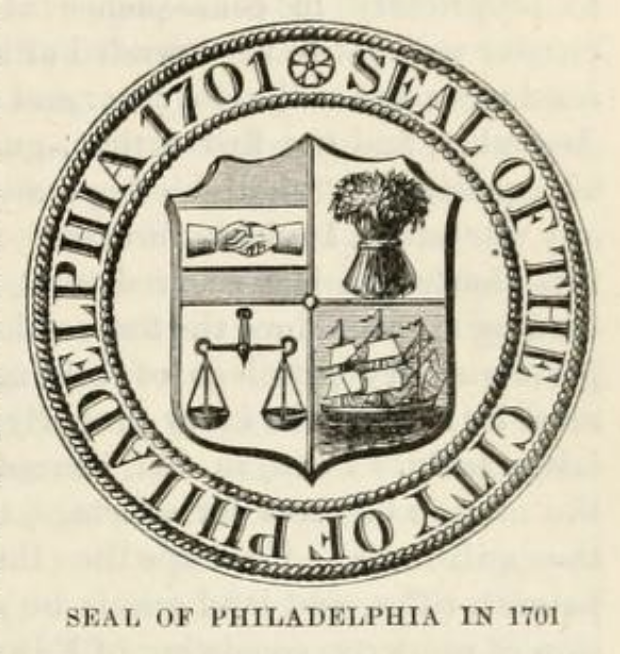
Flax was a plentiful colonial crop and was such an important commodity in Pennsylvania that the plant fiber was included in the seal for Germantown (along with a grape vine and a weaver’s spool). (5) Similarly, the 1701 seal of Philadelphia featured a five-petaled flax flower in the outer ring of text.

Growing flax and processing flax into fiber was extremely labor-intensive. To give a very general outline of the process: after harvesting the plant, the outer stalks of the flax must be removed (farmers would carefully let the outer stalks rot by keeping the plants wet – this process took a long time and was very smelly). After the time-consuming process of separating the outer stalks, the inner fibers would be dried, cleaned, and bleached. Finally, the inner fibers of flax were ready to be spun into thread. (6)
Spinning and weaving were tasks completed by women, and there are documented instances of colonists using both indentured and enslaved labor for the tasks of spinning. (7) Additionally, because linen had long been a traditional fiber in Ireland, Irish indentured servants and immigrants tended to be especially skilled at spinning and weaving. In 1759, one Andrew Burnaby visited Germantown and Philadelphia from England and wrote home about the material culture of the area: “The trade of Pennsylvania is surprisingly extensive... their exports are provisions of all kinds, lumber, hemp, flax, flaxseed, iron, furs, and deer-skins.” he also noted: “The Irish settlers make very good linens.” (8)
Despite the skill of workers, the production of linen in the colonies was never robust enough to become a large industry. As Michelle M. Mormul explains in her dissertation “The Linen and Flaxseed Trade of Philadelphia, 1765 to 1815”: “local production could never fill the Delaware Valley’s linen needs. Raw materials were always in short supply, workers did not improve the quality over time, and less than ten percent of the population had weaving equipment.” (9) While women in Pennsylvania were spinning and weaving linen on a small scale for their own clothing and household use, the vast majority of the extensive flax crops cultivated in Pennsylvania were not grown for fiber but for their seeds.
In 1775, flaxseed accounted for one seventh of the total value of exports leaving Philadelphia!(10) The vast majority (95% by the mid 1750s) of the flaxseed was shipped to Ireland.(11) Farmers in Ireland planted flax almost exclusively for its fibers and to achieve the softest and most valuable linen, they would harvest the plants when they were green and young, before any seeds had developed.(12) This meant that to sow the following year’s crops, they needed to purchase seeds.
Flaxseed grown in the Delaware Valley was a key commodity: “the flaxseed trade paid for linen, emigrants, and provisions from Ireland. It furthered the human trade, with payment send back to Ireland from Philadelphia.”(13) While most of the flaxseed would have been shipped away, a small percentage of harvested seeds would have been ground in a mill to produce linseed oil. This oil could have been used to produce varnish and could have eventually ended up in printer’s ink.
When considering American history, the cotton plant looms large as an economic force. But before the rise of “King Cotton”, the colonies – especially the mid-Atlantic colonies - were fueled by flax. Next time you encounter flaxseed in the baking section of a grocery store, use a linseed oil varnish in a project, or if you have any linen fabrics at home, remember that all these materials came from the flax plant.
An 1884 Manual of Flax Culture expands on the scientific name of flax: “The botanical name is Linum usitatissimum. The generic name, Linum, is the Latin name of the plant, which in Greek is Linon, in German Lein, in French Lin, and in Celtic, Llin. From these are derived our word linen, as well as lint, linseed and line. The specific name, usitatissimum, means most useful, and was given to it in reference to the service the fibre has rendered in furnishing clothing to the human family in all ages.”(14)
Notes
- Mark Barbour, “Linseed Rolls Beyond the Walls—The Tradition of Making Printer’s Ink,” The Wayzgoose Gazette of the International Printing Museum, Carson, California 10, no. 2 (2001): 1-3.
- Chris Browne, 2023, “Gutenberg, Chemistry and the Advancement of Knowledge,” Australian Journal of Chemistry 76, no. 8 (2023): 373.
- Browne, “Gutenberg,” 375-376.
- Lawrence Wroth, The Colonial Printer (The Southworth-Anthoensen Press 1938), 115-119.
- Alice Morse Earle, Home Life in Colonial Days (Macmillan, 1989), 181.
- See an illustrated explanation in Edwin Tunis, Colonial Living (The Johns Hopkins University Press, 1999), 48-49.
- Morse Earle, Home Life, 182-183.
- “Making Household Items, Philadelphia and Germantown (1759),” in Daily Life Through American History in Primary Documents, Volume I: The Colonial Period Through the American Revolution, ed. Randall M. Miller (Greenwood, 2012), 110.
- Michelle Mormul, “The Linen and Flaxseed Trade of Philadelphia, 1765 to 1815” (PhD diss., University of Delaware, 2010), 9, ProQuest (854512895).
- Mormul, “Linen and Flaxseed Trade,” 189.
- Mormul, “Linen and Flaxseed Trade,” 77.
- Mormul, “Linen and Flaxseed Trade,” 29.
- Mormul, “Linen and Flaxseed Trade,” 73.
- Manual of flax culture, comprising full information on the cultivation, management, and marketing of the crop. Together with a complete glossary and index, (Orange Judd Company, 1884), 1.
Bibliography
- Barbour, Mark. “Linseed Rolls Beyond the Walls—The Tradition of Making Printer’s Ink.” The Wayzgoose Gazette of the International Printing Museum, Carson, California 10, no. 2 (2001): 1-3.
- Browne, Chris. “Gutenberg, Chemistry and the Advancement of Knowledge.” Australian Journal of Chemistry 76, no. 8 (2023): 372-378. https://doi.org/10.1071/CH22253
- Keyser, Naaman, Henry Kain, John Palmer Garber, Horace McCann. History of Old Germantown. Horace F. McCann, 1907. https://archive.org/details/historyofoldgerm00keys/page/n11/mode/2up
- “Making Household Items, Philadelphia and Germantown (1759).” In Daily Life Through American History in Primary Documents, Volume I: The Colonial Period Through the American Revolution, edited by Randall M. Miller. Greenwood, 2012.
- Manual of flax culture, comprising full information on the cultivation, management, and marketing of the crop. Together with a complete glossary and index. New York, Orange Judd company, 1884. Pdf. https://www.loc.gov/item/ca17002894/.
- Mormul, Michelle. “The Linen and Flaxseed Trade of Philadelphia, 1765 to 1815.” PhD diss. University of Delaware, 2010. ProQuest (854512895).
- Morse Earle, Alice. Home Life in Colonial Days. Macmillan, 1898.
- Scharf, J. Thomas and Thompson Westcott. History of Philadelphia 1609-1884, Volume I. L. H. Everts & Co., 1884. https://archive.org/details/historyofphilade01scha/page/n7/mode/2up
- Tunis, Edwin. Colonial Living. The Johns Hopkins University Press, 1999.
- Wroth, Lawrence. The Colonial Printer. The Southworth-Anthoensen Press, 1938.