
Workers, Apprentices, and Unions in the Revolutionary Era
In 1786, just ten years after the Declaration of Independence was printed in Philadelphia and ignited the Revolutionary War, some printers in Philadelphia attempted to lower the wages of journeymen currently in their employ. In response, a group of journeymen gathered together and vowed to resist by withholding their labor.
One of the popular workshops Common Press offers here at the University of Pennsylvania is the one-hour “Studio Use Training”. In this introductory workshop, Common Press staff explain the basics of printing for beginners, covering proper typesetting, leading, and spacing, ink mixing, press setup and operation, and type distribution and cleanup. Workshop participants get to set type, pull their own print, and they leave with a general understanding of printing fundamentals.
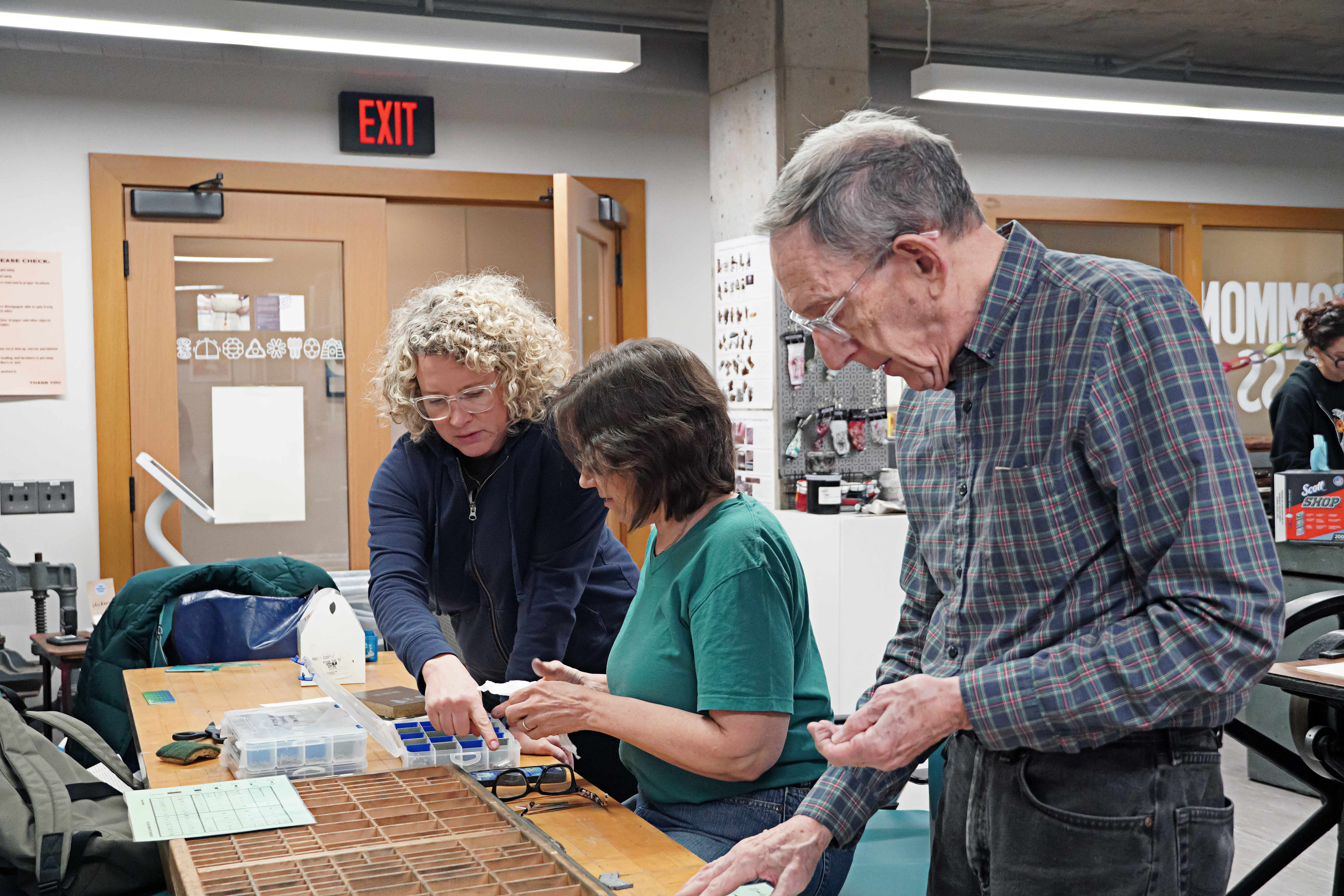
Printing, like many crafts, is best learned by doing and these Studio Use Trainings follow the long tradition of printers passing down the skills of the trade to new, inexperienced people who are eager to learn. For centuries, print shops were full of apprentices, journeymen, and master printers, all at different stages of competency in the craft. In the Revolutionary era, as in today, divisions of labor provoked both tensions between employers and employees and at the same time, presented opportunities for camaraderie amongst laborers.
Apprentices, Masters, and Guilds
The apprentice system in the American colonies was a practice inherited from European guilds. Guilds were originally formed in the Middle Ages to control the quality of work, prices charged, and wages paid to workers in various crafts such as blacksmithing, silversmithing, tailoring, etc. After completing a seven year long (unpaid!) apprenticeship, workers would rise to the rank of journeymen to continue to refine their skills and, importantly, to earn wages. Eventually journeymen could submit their own “masterpiece” to the guild for consideration for the status of master. [1]
While formal guilds did not materialize in the American colonies, artisans did organize with other tradesmen to keep their profits as high as possible. We know that the Carpenters’ Company of Philadelphia (established in 1724), “was an organization of master builders devoted to minimizing competition by establishing uniform rates for their work” and “In 1771, Philadelphia’s master tailors organized a similar group to fix prices and limit journeymen’s wages.” [2] Just as the master printers organized amongst themselves to protect their interests, journeymen likewise banded together with their peers. As we shall see, their collective actions are among some of the earliest known examples of paid laborers organizing for higher wages in American history.
Printer’s Devils
Being a printer’s apprentice was tough work, even under the most generous of masters. In “The Tyranny of Printers”, Jeffrey L. Pasley explains: “One of the first chores that would be delegated to a young apprentice printer was preparing the sheepskin balls used to ink the type. The skins were soaked in urine, stamped on daily for added softness, and finally wrung out by hand, the work got harder from there, and only a little more pleasant.” [3] There were fires to be lit and tended to, never ending piles of jumbled type (this is called “pied type”) to sort, floors to be swept, and errands to be run. Often, the youngest apprentice in a printing shop would be called the “Printer’s Devil” and was blamed for print errors or other mistakes around the shop. [4]
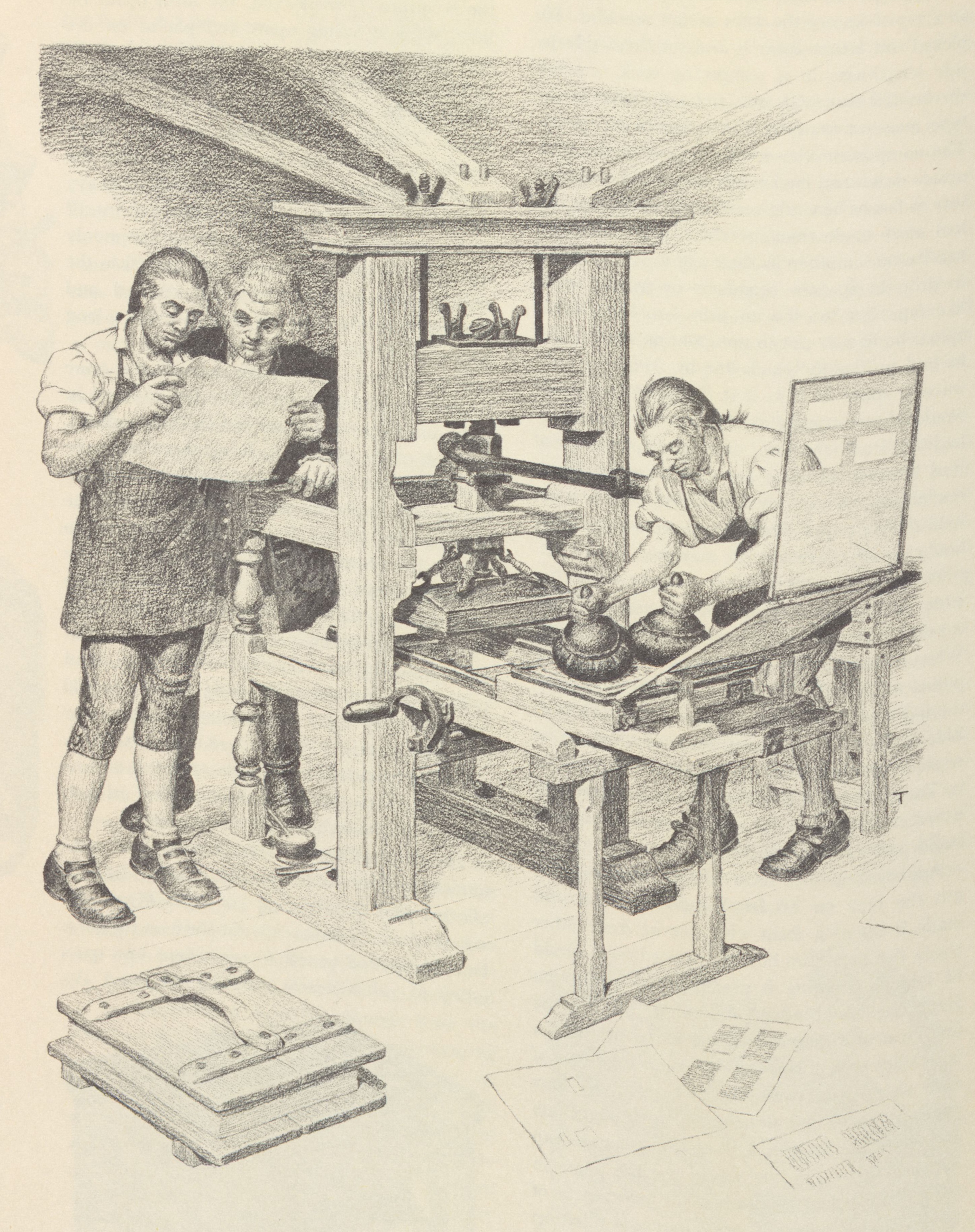
Because there was no guild to provide guard rails, some artisans in the American colonies took advantage of the apprentice system by taking on more apprentices than he could provide adequate training for and by treating these apprentices very poorly. [5] Beatings were not uncommon, and some apprentices ran away rather than continue to be subjected to poor conditions at a shop [6]. We know that apprenticeship was a life stage only available to young men, and if they could stomach seven years of working under a master and living in his house, learning the trade was a chance at upward mobility. Printing was considered a “high-status” craft; unlike tailoring, shoemaking, or candlemaking, it afforded a high level of social status. Furthermore, as historian William Rorabaugh explains: “the craft was lucrative. A growing population and increased literacy, as well as increased commerce and political controversy, gave the colonial printer a growing market.” [7]
Journeymen
At the completion of seven years of apprenticeship, a young man was given his “freedom dues” (traditionally, a new suit of clothes) and rose to the status of journeyman. Now able to earn wages for his work, he might stay on with the same printer, if a position was available, or move to work for a new printer, perhaps in a different town. Rorabaugh summarizes: “A journeyman, as the word suggests, would move willingly around the country in search of the best pay in order to hasten the day when he could set up his own shop.” [8] This mobility was an attractive opportunity for some, but moving likely did not lead to dramatic wage increases because, as we have already learned, many printers consulted with each other and set standard journeymen wages across an area.
“RESOLVED”
In 1786, just ten years after the Declaration of Independence was printed in Philadelphia and ignited the Revolutionary War, some printers in Philadelphia attempted to lower the wages of journeymen currently in their employ. In response, a group of journeymen gathered together and vowed to resist by withholding their labor. On Friday, June 2nd, the following statement appeared in the weekly Pennsylvania Mercury and Universal Advertiser:
“At a meeting of the Journeymen Printers of this city, held at the house of Henry Myers, on Wednesday, the 31 st ult., the following Resolutions were unanimously entered into, and ordered to be transcribed for publication, viz.
In consequence of an attempt having been made by some of our employers to reduce our wages to thirty-five shillings per week.
RESOLVED, That we will not engage to work at any Printing-Office in this city or county, under the sum of Six Dollars per week.
RESOLVED, That we will support such of our Brethren as shall be out of employment on account of their refusing to work for less that Six Dollars per week.”
Twenty-six men signed their names to this declaration, which, as historian George Tracy notes, was “probably … a majority of the competent (journey)men in the city at that time” [9]. The statement was reprinted in three other newspapers in the following days and, as best as historians can tell, “these were the first American workers who deliberately voted to stand out for a specific wage and to provide mutual assistance in maintaining it.” [10]
This act of solidarity is made even more significant when we realize the journeymen noted: “some of our employers…” had attempted to reduce their wages, not all of their employers. Unaffected journeymen could have kept their names out of this fight, but they knew they were stronger together and they agreed to strike with their fellow workers. The provision to “support our Brethren” is believed the be the first example of a strike fund ever organized in the United States.
Printers and Labor History
In fact, printers paved the way for a number of significant labor history milestones. In his Chronology of Labor History in the United States, Russell O. Wright states: “The first national union considered to remain in permanent existence was the International Typographical Union, which was formed in 1852 following a series of meetings that began in 1850…” [11]
Prior to an 1842 Massachusetts Supreme court case, in the United States “It was considered illegal to even join a union because unions ‘conspired’ to raise wages.” [12] So, while there were examples of unions prior to the Typographical Union, they were short-lived and vulnerable to charges of criminal conspiracy. Such was the fate of the first-ever American union, the society of Philadelphia Shoemakers, formed in 1792 but disbanded in 1806 when it “was found guilty of criminal conspiracy for founding a union and striking”. [13]
The International Typographical Union was also the first union in the United States to open a home for the care of “sick and indigent” members. [14] The Union Printers Home was opened in 1892 in Colorado Springs, was fully funded by union fees, and primarily cared for printers with “consumption”, the historical term for tuberculosis. Printers were especially vulnerable to this disease because their daily exposure to lead caused lead poisoning, which made them less resistant to infections. [15 ] The Union Printers Home was an act of community care, demonstrating that typographical workers in the 20th century must have felt just as strong a connection to their “brethren” as printers did in 1786.
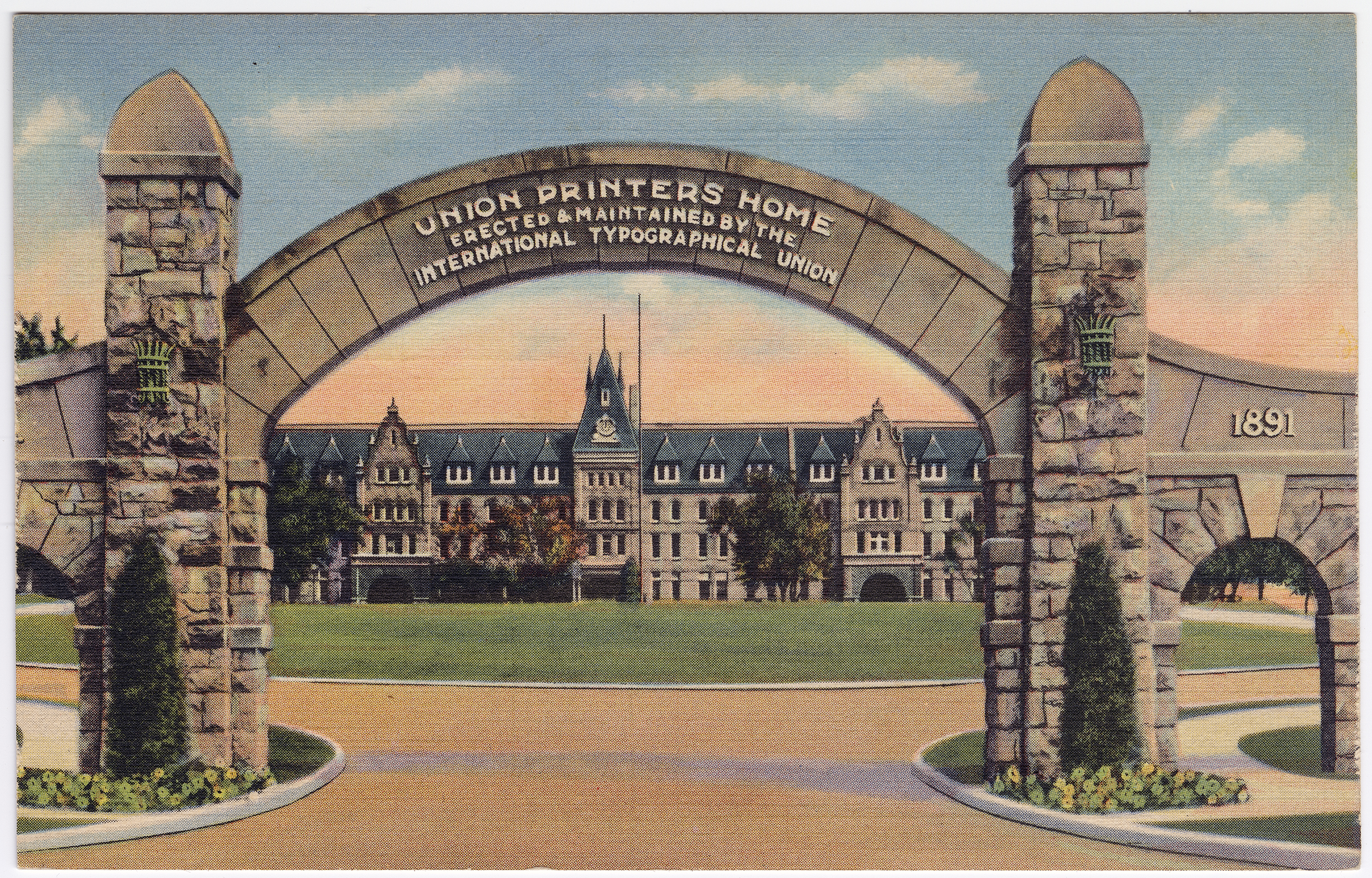
The Union Printers Home operated until 2014 (although by that time it admitted nonunion residents) when it was sold to a private nursing home corporation. The property is currently undergoing redevelopment planning to become a “mixed-use neighborhood”.
Standing Up for Workers Rights: In Unions and Individually
While history in general (and Philadelphia specifically) loves to celebrate “firsts”, we know that for centuries people have stood up against the exploitation of their labor and have fought for their wages, both in groups with fellow workers and as individuals demonstrating alone. All too often, these people are not named in the historical record.
Take, for example, one of the printers Philadelphia publisher Matthew Carey mentions in his autobiography. Carey recounts that in the early 1790s he frequently did not have enough money to pay his employees. He writes, “I… was often unable to pay my journeymen… One resolute negro pressman, who had not received his wages on Saturday night, refused to go to work on Monday morning. ‘He was not,’ he said boldly, ‘going to starve in the midst of the fat of the land.’” [16] As scholar of the early American book trade John J. Garcia writes, “Carey chose his words carefully. The printer was resolute—determined and unwavering in the face of a white employer. He confronted Carey in a struggle to survive, to feed himself and maybe a family too.” [17]
As we approach the 250th anniversary of the Declaration of Independence, we might feel that our daily struggles are radically different from the concerns and struggles of people living in the late 1700s. In important ways, however, we can see that the fight for worker’s rights and the struggle for fair wages has spanned generations. From these printers from the past, we can learn that there is strength in unity, and that the first step to winning labor rights is to make a demand.
Notes:
[1] Ian Chilvers, “Masterpiece” in The Oxford Dictionary of Art and Artists, (Oxford University Press, 2015), https://www-oxfordreference-com.proxy.library.upenn.edu/view/10.1093/acref/9780191782763.001.0001/acref-9780191782763-e-1566. W. J. Rorabaugh, The Craft Apprentice: From Franklin to the Machine Age in America, (Oxford University Press, 1986), 4, EBSCOhost.
[2] William E. Burns, “Artisans” in Colonial America: An Encyclopedia of Social, Political, Cultural, and Economic History, ed. James Ciment (Routledge, 2006), 121-124, https://doi-org.proxy.library.upenn.edu/10.4324/9781315705545.
[3] Jeffrey L. Pasley, “The Tyranny of Printers”: Newspaper Politics in the Early American Republic, (University of Virginia Press, 2001), 25.
[4] “Devil” in American Dictionary of Printing and Bookmaking, (H. Lockwood & Co., 1894), 136, https://archive.org/details/americandiction00paskgoog/page/136/mode/2up.
[5] Rorabaugh, The Craft Apprentice, 5.
[6] Ralph Frasca, “From Apprentice to Journeyman to Partner: Benjamin Franklin’s Workers and the Growth of the Early American Printing Trade,” The Pennsylvania Magazine of History and Biography 114, no. 2 (1990): 283, https://www.jstor.org/stable/20092470.
[7] Rorabaugh, The Craft Apprentice, 6-7.
[8] Rorabaugh, The Craft Apprentice, 8.
[9] George Tracy, History of The Typographical Union, (International Typographical Union, 1913), 18.
[10] Henry P. Rosemont, “Benjamin Franklin and The Philadelphia Typographical Strikers of 1786,” Labor History 22, no. 3 (1981): 399, https://research-ebsco-com.proxy.library.upenn.edu/c/zhpoyd/viewer/pdf/42m6ik5pfj.
[11] Russell O. Wright, Chronology of Labor History in the United States, (McFarland & Company, Inc., 2003), 17.
[12] Wright, Chronology of Labor History in the United States, 6.
[13] Wright, Chronology of Labor History in the United States, 5.
[14] Tracy, History of The Typographical Union, 1129.
[15] “Tuberculosis Among Printers,” The British Medical Journal,1, no. 3560 (1929): 611-612.
[16] Mathew Carey, Mathew Carey Autobiography, (Research Classics, 1942), 22, https://archive.org/details/mathewcareyautob0000care.
[17] John J. Garica, “Critique! Critique! Critique! Black Labor in the Early American Book Trade,” Criticism 64, no. 3/4 (2022): 324, https://doi.org/10.1353/crt.2022.a899722.